Pages

Wednesday, March 5, 2014

WPP#12: Unit O Concept 10

http://cdn.snowboardermag.com/files/2009/10/IMG_4157.jpg
The Problem:Lauren has a week off from work and decides to go snowboarding at the mountains and stay at a resort. When she arrives, she is admiring the snow white mountain at ground level at the snowboarding resort "Mountain High." 


a) Lauren measures the angle of elevation to the top of the mountain to be 60*. If, at this point, she is 60 feet away from the mountain, what is the height of the mountain?


b) Lauren reaches the top of the mountain and see's her friends waving at her and encouraging her to ride down the mountain. She now see's the flag where she is supposed to snowboard down and she measures the angle of elevation to the flag to be 20*. How long is the path to the flag? [keep in mind to use the height of the mountain]


The Solution: a) Draw out the mountain and draw a person some distance away from it. Then draw a line from the top of the mountain to the persons feet and then draw a line connecting the person to the bottom of the mountain. That line will be 60. The angle we just made will be 60*. Now label the height of the mountain x and that is the one we will be solving for. Now we are going to be using tangent to find the height of the mountain. The equation should be tan(60)=x/60. multiply both sides by 60 and the answer should be x=103.9 ft. 


b) Draw the mountain again but this time put a person on top of the mountain and a flag some distance from the mountain. Connect the flag to the person and that will be our x. Make a flat line across the top of the mountain and then connect the flag to that line. That will create a height which will be the height of the mountain, being 103.9. Now, using sin, we will find the distance from the person to the flag. The equation should be sin(20)=103.9/x. Multiply both sides by x and then divide both sides by sin(20). The answer should be 303.8 ft. 

*anything highlighted are important to solving the problem*

Monday, March 3, 2014

I/D2: Unit O - How we derive the patterns for our special right triangle?

Inquiry Activity Summary

[Property of Kelsea]
1. A 30-60-90 triangle is derived from an equilateral which is cut in half. An equilateral is a triangle where all sides are equal as well as all angles. All the angles in the equilateral triangle are 60* and all the sides are 1. When we cut the triangle in half, we get different angles and sides. half of the triangle is now made up of angles which are 90*, 60* and 30*. The 60* is the one that was not affected by the cut. The 30* is the one at the top where the angle was cut in half, which makes sense since half of 60* is 30*. The 90* comes from the bottom where the side is perfectly perpendicular to the bottom side. The sides are now different as well. The hypotenuse, the slanted on, is not affected by the cut so is remains 1. The bottom one, which is cut in half becomes 1/2. However, there is no given value for the side that has been cut. In order to find that side, we use the Pythagorean Theorem [a^2 + b^2 = c^2]. The hypotenuse is c, the bottom side is a, and w solve for b. Once we plug it all in and solve for b, the answer should be b=√3/2. Now the sides should all be as follows: a=1/2, b=√3/2, and c=1. Now, since nobody is very fond of fractions, we can multiply all the sides by 2 to eliminate the fractions. Now the sides should be a=1, b=√3, and c=2. Now we are almost done! Now we must add an n to each side number because although the angles will remain, the sides are subject to change. That means n can be any number and the angles will remain the same. So finally, one last time, lets list what the angles are: a= n, b=n√3 [n should not be behind it], and c=2n. Our 30-60-90 triangle is now derived and conquered!
[Property of Kelsea]


[Property of Kelsea]


[Property of Kelsea]


[Property of Kelsea]
2. A 45-45-90 triangle is derived when a square is cut diagonally. A square is a shape where all four sides are equal [in this case we will set them equal to 1] and all sides are 90*. When cut diagonally, the two angles change, and one side changes. Since it is cut diagonally, the two angles affected will become 45* which makes sense because half of 90 is 45. The other angle remains 90* since it was not affected by the cut and it is perfectly perpendicular to the bottom side. Two of the sides were not affected, the ones that are not slanted, so they remain 1. However, one was, the hypotenuse. In order to find the hypotenuse, we must once again use the Pythagorean Theorem [a^2 + b^2 = c^2] to find the hypotenuse. Hypotenuse will be c, the bottom side will be a, and the other side will be b. Now we plug our numbers into the equation and solve for c. The answer should b √2. Now all our angles should be as follows: a=1, b=1, c=√2. Yay! Wait ... we are forgetting something that we did in the 30-60-90 triangle. What is it? Oh Right! Our lovely buddy n. Add n to all the sides because, as stated before, the angles can remain the same but the sides are subject to change! So now, our sides should be a=n, b=n [It is 1n but since any number multiplied by 1 is that number, we do not need the 1], and c=n√2 [remember, no n behind the radical!]. Congratulations! The angles are now derived and we now know how to derive the 45-45-90 triangle! Good Job!

[Property of Kelsea]
[Property of Kelsea]


[Property of Kelsea]


Inquiry Activity Reflection

1. "Something I never noticed before about special right triangles is ..."  that the sides are found using the Pythagorean Theorem equation. [Hypotenuse for 45-45-90 and the b for the 30-60-90]
2. "Being able to derive these patterns myself aids in my learning because..." if I ever forget what the side is, I can derive it using the what I learned from this activity, which is to cut a square diagonally for a 45-45-90 or an equilateral triangle for a 30-60-90 and then use the Pythagorean Theorem to find the angle that is missing.

Saturday, February 22, 2014

I/D #1: Unit N Concept 7: How Do SRT And UC Relate?

Inquiry Activity Summary

[Kelsea Del Campo; worksheet]
1. The 30* triangle is one of the special right triangles that is taught to us in Geometry. This means that each side has a special equation that goes with it. The hypotenuse is 2x, the horizontal angle is x, and the vertical angle is x radical 3. Now, we have to identify which is the x and y. The horizontal is x and the vertical is y. The hypotenuse is r, which refers to being a reference angle, the angle from the terminal side to the closest x axis. Now if we set the reference angle equal to one, we have to do that to all of the other sides by dividing by 2x. This means that we have to divide by 2x on the horizontal and vertical side. This means our hypotenuse will equal 1, our vertical angle equal to 1/2, and our horizontal angle equal to radical 3 over 2. Next I drew a coordinate plane where the triangle was in the first quadrant. Then I labeled the vertices into ordered pairs. The edge is (0,0) since it is at the middle of the graph. The one to its right is ( radical3/2, 0) because the x is radical3/2.  The one above it is (radical3/2, 1/2). The last ordered pair is a point on the unit circle and its angle is 30*. This can help us identify the ordered pair on the unit circle with a reference angle of 30*, depending on which quadrant one or both will be negative. 


[Kelsea Del Campo: worksheet]
2.  The 45* angle is also a special right triangle. The hypotenuse is x radical2, the vertical side is x, and the vertical side is also x. Now we also have to identify x and y. X will be the vertical side and y will be the horizontal side. The hypotenuse is, again, r. We have to set the hypotenuse equal to 1 again so we divide all three sides by x radical2. After doing so, our r should equal 1, our y should equal radical2/2, and our x should equal radical2/2. Next draw a coordinate plane with the triangle in the first quadrant. Label the verices as ordered pairs. The edge is (0,0), the one beside it is (radical2/2, 0), and the one above it is (radical2/2, radical2/2). The last ordered pair is a point on the unit circle with an angle of 45* and can help us find the ordered pairs for an angle with a reference angle of 45*, depending on which quadrant one or both will be negative. 


[Kelsea Del Campo: worksheet]
3. The 60* angle is very similar to the 30* except that everything is switched. This means that the vertical side is x radical3 but remains y. The horizontal is now x but remains the x. The hypotenuse remains the same. Set the hypotenuse equal to 1 by dividing by 2x and divide the rest by 2x as well. Now the hypotenuse should equal 1, the y should equal radical3/2, and the x should equal 1/2.Next, draw a coordinate plane where the triangle is on the first quadrant. Then identify the vertices as ordered pairs. The edge should be (0,0), the one beside it should be (1/2,0) and the one above it should be (1/2, radical3/2). As before, the last ordered pair is a point on the unit circle and is the same ordered pair for that with a reference angle of 60*, depending on which quadrant one or both will be negative.

4. This activity helps us derive from the unit circle because when we look at the unit circle and look at all reference angles of 30*, it has the same ordered pair, depending on the quadrant a negative will be present. Any angle with a reference angle with 45* has the same ordered pair, depending on the angle there will be a negative on the x or y, or both. Lastly, for any angle with a reference angle of 60*, it will have the same ordered pair, and depending on the quadrant, the x or y or both will be negative.

[Kelsea Del Campo: phone]
5. The triangle drawn in this activity all lie in the first quadrant. If we draw the triangle in the second quadrant, it will be a mirrored image of the first quadrant, the third quadrant will be a mirrored image of the second quadrant, and the fourth quadrant will be a mirrored image of the third quadrant. The closest angle to the x-axis is going to be an angle with a reference angle of 30*, the middle will that with a reference angle of 45*, and the one closest to the y-axis will e the one with the reference angle of 60*. The x's in the second quadrant will be negative, x and y will be negative in the third quadrant, and the y in the fourth quadrant will be negative. The 45* angle is shown in the second quadrant and is like a mirror image of the one in the first quadrant. It has the same ordered pair but its x is negative. The 30* angle is in the third quadrant and is upside down and the x and y of the ordered pair is negative. Lastly, the 60* angle us also upside down but only the y is negative.
[Kelsea Del Campo: phone]
[Kelsea Del Campo: phone]


Inquiry Activity Reflection

1. "The coolest thing I learned from this activity..." was how the special right triangle corresponds are are very similar in each quadrant. I didn't learn in Algebra II where these numbers came from so that was also interesting.

2. "This activity will help me in this unit because..." we are currently memorizing the unit circle to help us the sin, cos, and tan so it will help in finding the answer. 

3. "Something I never realized before about special right triangles and the unit circle is ..." that we get the ordered pairs from the special unit circle when we set the hypotenuse equal to 1 and that the triangle can be found in the unit circle itself. 

Monday, February 10, 2014

RWA1: Unit M: Concept 4-6: Conic Sections In Real Life

[http://www.youtube.com/watch?v=7mqUYWtRL5Y]


1. "The set of all points such that the sum of the distance from two points is a constant. " (Mrs. Kirch/SSS Packet)

2. The equation for this conic section, the ellipse, is (x-h)²/a²+(y-k)²/b²=1 or (x-h)²/b²+(y-k)²/a²=1. The center will always be the h and k. H will be paired with the x and the k will be paired with the y. The a will always be bigger than the b. Where the a is placed will determine whether the graph is skinny or fat. If the a² is under the (x-h)², it will be fat/wide. If the a² is under the (y-k)², it will be skinny/long. The equation will always be equal to 1 and the equation will always be added.The ellipse on a graph looks like an elongated circle. It can look fat/wide or it can look skinny/tall. 
The key features on the ellipse are the center, two vertices, two co-vertices, two foci, major axis, minor axis, and the position/look of the ellipse. The key features in the equation that will be needed to find the key features on the graph are the standard form, center, a, b, c, and the eccentricity. The easiest way to graph an ellipse is to obtain the standard form first. To find the equation, you complete the square. After doing so, divide everything by the number that is on the right side so the equation will be equal to one. After that, identify the circle by looking at both numerators. The h will be associated with the x and the k will be associated with the y. Since the numerators are  (x-h)² and (y-k)². That means the center is just (h, k). However, if your standard form has a (x+h)², then the h will be a negative; the same concept applies to the y and the center may be (-h, -k) depending on which numerator has addition. Then plot the center. Now go back to the equation and determine if the graph is going to be fat/wide or skinny/tall. The graph will be fat/wide if the a² is the denominator for the (x-h)². The graph will be skinny if the a² is the denominator for (y-k)². After identifying the shape of the graph, find your a and b. Since in the equation is is squared, you need to square root it to find the distance from the center to one endpoint of the major/minor axis and the other endpoint of the major/minor axis.Now that a and b have been found, to find the vertices and co-vertices (a is associated with vertices and b is a associated with co-vertices) we need to observe the shape of the graph again. If it is wide /fat, the y (meaning the y from the center) in the ordered pair for the vertices will stay the same and the x (meaning the x from the center) in the ordered pair so you have to add and subtract the y from the center to get the other number for the ordered pair. If it is wide/fat, the x in the co-vertices will remain the same so we have to add and subtract the y from the center to get the other numbers for the ordered pair.The same thing goes for skinny/tall but vice-versa meaning the a in the vertices stays the same and the y in the co-vertices stays the same. Plot the vertices and connect the two endpoint with a solid line and plot the co-vertices and connect the two endpoint with a dashed line, that way it will be easier to identify which line is which. Now just draw you ellipse and you are done! Just kidding! But you're almost there! Now we have to find c, which will help us in finding the foci. To find c, we use the equation a²-b²=c². After plugging in  the equation and finding the c, we need to find the ordered pair of it so we can graph it. Look at the vertices and whatever number stays, the x or the y, then the same will go for the foci since the foci will be on the major axis like the vertices. Now just add or subtract from the other number, x or y depending on the shape, and plot. The purpose of the foci is to know the how fat/wide or how skinny/tall it is since the sum of two distance from the foci is a constant. The farther from the center, the more elongated it will be and if closer to the center it will be less elongated. Now we need one more thing! The eccentricity! to find the eccentricity, we need to use the equation c/a. The number should be between 0 to 1. Since it is in between 0 and 1, then that means an ellipse deviates from being a circle a little bit. 

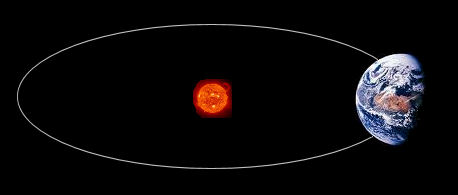
3. Conics of ellipses can be seen where very few men have gone: space. The rotation of the planets around the sun form an ellipse. Another space example would be Haley's Comet. It has a rotation that is shaped like an ellipse. An ellipse that isn't so out of this world is a glass of water. When tilted slightly, the surface of the water can be viewed to look like an ellipse. Ellipses can be found in common places as well: buildings, statues, car logos, and even more places! Can you find all of them?

4. Works Cited:
http://britton.disted.camosun.bc.ca/jbconics.htm
http://www.youtube.com/watch?v=7mqUYWtRL5Y
http://intmstat.com/plane-analytic-geometry/earth.jpg

Monday, December 9, 2013

SP#6: Unit K Cpnxept 10: writing repeatinf decimals as a rational number using geometric series

Make sure that when solving this problem, you remeber the correct way to use summation notation. Also, remember what the infinite geometric series equation is. Lastly, remember that this is an infinite series, not a finite.